Writing compound sentences
Written by Adi Ackerman, Head Teacher
"Writing compound sentences - Chess pieces" is written for 3rd Grade (Ages 8-9), and it covers Common Core L.3.1.I. If your little one is a year younger but already steady on sentences, the page still works. You may just need to read the instructions out loud. And if they are older and compound sentences never quite stuck, this is a short review rather than busywork.
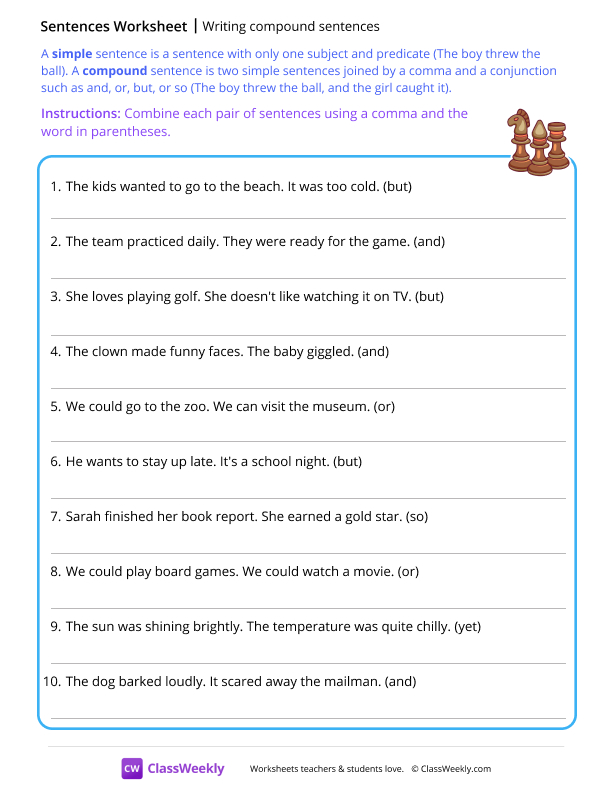
Free printable writing compound sentences (chess pieces) worksheet for 3rd grade students. Part of our compound sentences collection. Aligned to Common Core standards.
How do I use this worksheet?
Introduce the skill with a brief whole-class activity, such as calling out examples and asking students to give a thumbs up when they hear compound sentences in a sentence. Then let students work through it independently, using a partner or small group only if they want to talk through their thinking, referring to a class anchor chart if one is available. When reviewing answers, ask students to explain why an answer is correct rather than just confirming it. These compound sentences worksheets work well as a focused practice activity, a homework assignment, or a warm-up at the start of a language arts lesson.
What students will practice
- Students will identify and correctly use compound sentences in sentences and short passages.
- Students will distinguish compound sentences from related language concepts and apply rules consistently.
- Students will demonstrate understanding of compound sentences through guided and independent practice, in both reading and their own writing.


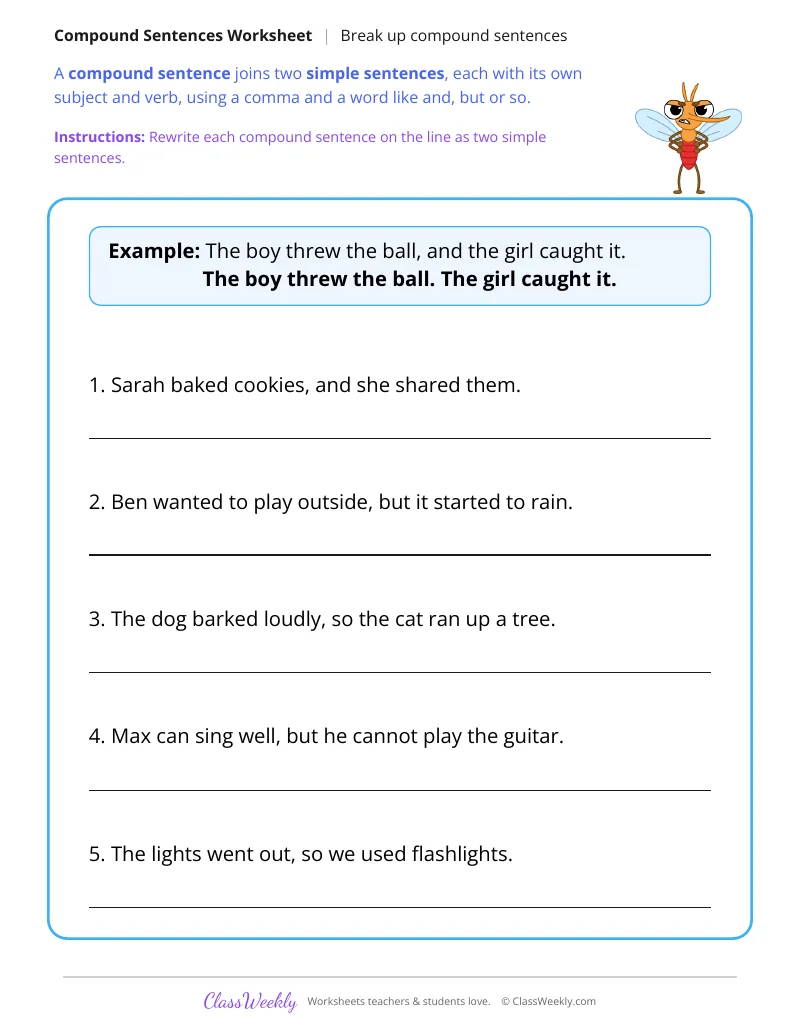


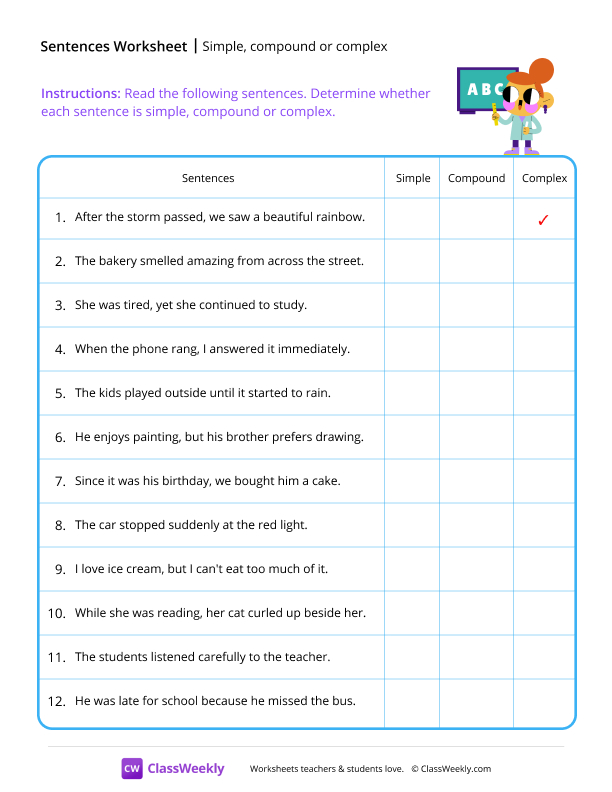


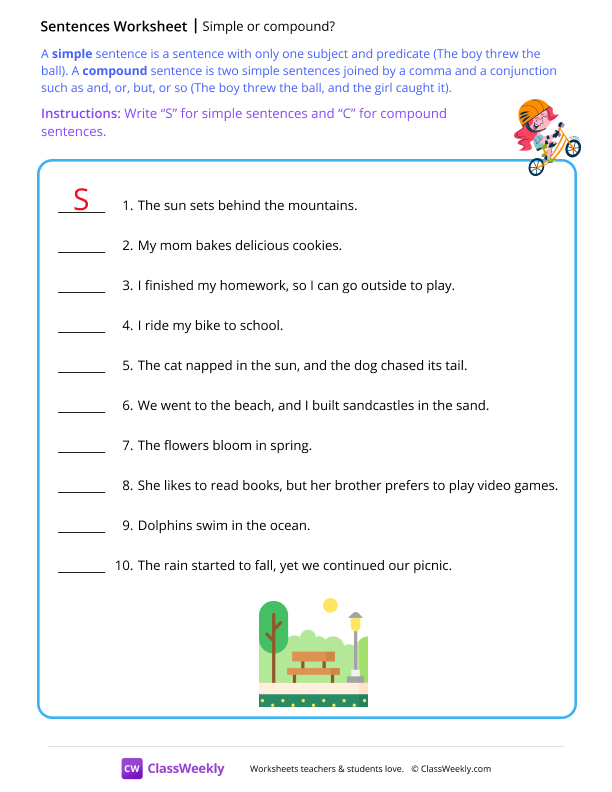
Curriculum Links
Common Core State Standards
Language · 3rd Grade
Standard: Produce simple, compound, and complex sentences.
View all L.3.1.I worksheets →Find this in the curriculum
Browse the grade, subject, and topic this belongs to.
FAQ
How do I use this compound sentences worksheet?
⌄
Introduce the skill with a brief whole-class activity, such as calling out examples and asking students to give a thumbs up when they hear compound sentences in a sentence. Then let students work through it independently, using a partner or small group only if they want to talk through their thinking, referring to a class anchor chart if one is available. When reviewing answers, ask students to explain why an answer is correct rather than just confirming it. These compound sentences worksheets work well as a focused practice activity, a homework assignment, or a warm-up at the start of a language arts lesson.
What does this worksheet teach?
⌄
These compound sentences worksheets for 3rd grade give students the targeted language arts practice they need to master this important grammar skill. Students identify, sort, complete, and write using compound sentences through a variety of exercises designed to reinforce both recognition and application. Our sentences worksheets connect grammar practice to reading and writing so students see how compound sentences works in real language. Building a solid understanding of compound sentences in 3rd grade sets students up for stronger writing and clearer communication in every subject.
Can I use this compound sentences worksheet for homeschool or classroom?
⌄
Yes, both. We made it for 3rd Grade sentences, and the page works the same whether it lands on a kitchen table or a center rotation. At home, most families go through it together and talk the answers out loud, and that talking is where most of the learning happens with compound sentences. In class it runs well as independent work while you pull a small group. Print one copy or thirty, whichever the day needs.
What is the correct punctuation rule for compound sentences?
⌄
When two independent clauses are joined by a coordinating conjunction (and, but, or, so), a comma must come before the conjunction - for example, 'She studied hard, so she passed the test.'
How do compound sentences improve 3rd grade writing quality?
⌄
Using compound sentences shows readers how two related ideas connect, reduces choppy sentence patterns, and demonstrates growing sentence fluency - all of which are markers of writing growth in 3rd grade.
What is the most common mistake students make with compound sentences?
⌄
The most common error is forgetting the comma before the coordinating conjunction, which creates a run-on sentence - worksheets reinforce the comma rule through repeated pattern practice.
What are the four types of sentences?
⌄
Declarative sentences tell (.), imperative sentences command (. or !), interrogative sentences ask (?) and exclamatory sentences show strong feeling (!). The sort page puts 12 sentences into the 4 types, 3 in each box.
What is the difference between simple, compound and complex sentences?
⌄
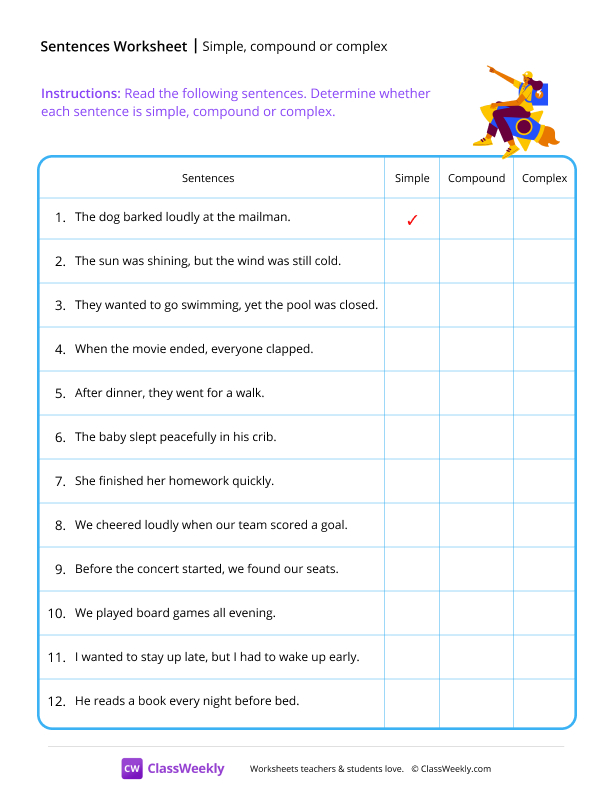
A simple sentence has one complete thought. A compound sentence joins two complete thoughts with a word like and, but or so. A complex sentence adds a part that cannot stand alone, often starting with because, when or although.
How do I help my child fix a run-on sentence?
⌄
Read it aloud and listen for where one thought ends. Then split it into two sentences with a period, or join the parts with a comma and a word like and, but or so.
Ratings & Reviews
No reviews yet. Be the first to share what you think.
Reviews are for ClassWeekly members.
Make a Request
Spotted something to fix, or want a worksheet we don't have yet? Tell us and we'll make it.
Worksheet Details
| Grade | 3rd Grade |
| Subject | Grammar & Writing |
| Topic | Sentences |
| Standard | L.3.1.I |
| Pages | 1 page |
| Difficulty | Medium |
Learn More
What is ClassWeekly?
ClassWeekly offers free worksheets and printable learning resources for kids, from preschool up. All worksheets are aligned to Common Core, NGSS, and C3 Framework standards and designed by educators. Become a member to access the full library and download unlimited PDFs.